Celenderis: A Fifth-Century Silver Stater from Western Cilicia
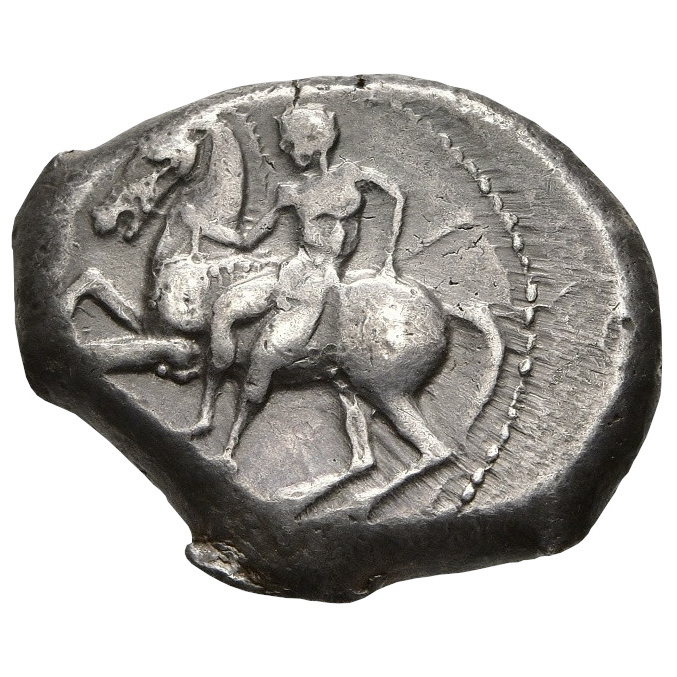
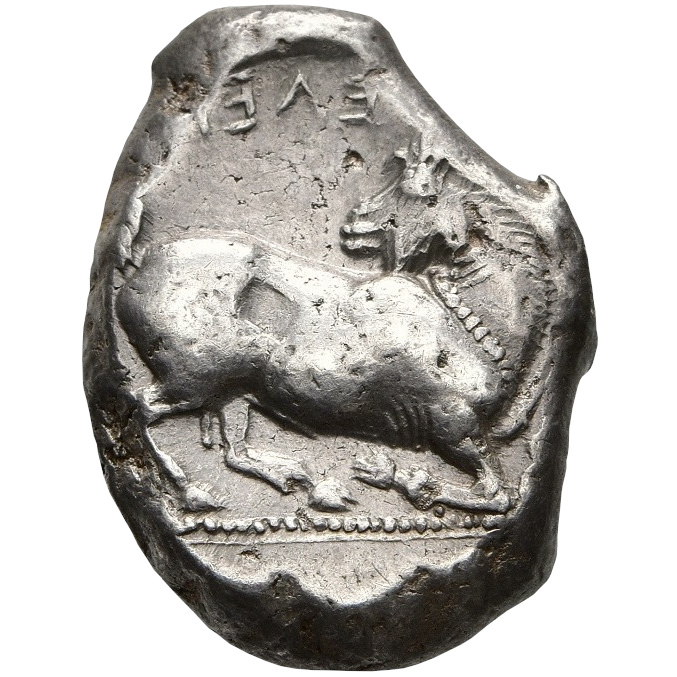
In the fifth century BC, on the rugged coastline of western Cilicia, the maritime city of Celenderis occupied a strategic harbor bounded by steep coastal mountains. Due to its relative isolation from the Anatolian interior, the city maintained an outward focus toward Mediterranean trade routes 1.
To facilitate local and external trade, the municipal mint produced silver staters with distinctive civic imagery. The obverse type depicted a naked rider dismounting from a prancing horse, while the reverse featured a kneeling goat with its head turned back. Both motifs functioned as visual wordplay (puns) on the name Celenderis 1.
A notable feature of these staters is the retrograde legend ΚΕΛEN, inscribed from right to left on the reverse. While Greek writing conventions in the central Aegean were increasingly standardizing to a left-to-right format 2, right-to-left script direction persisted in peripheral administrative regions like Cilicia. This was largely sustained by the regional prevalence of Aramaic and Phoenician, both of which were Semitic right-to-left scripts.
Administratively, Cilician mints were divided into two distinct geographic zones 3:
- Western Cilicia (Celenderis, Nagidus, Holmi): Mountainous terrain limited overland access, leaving these coastal cities largely exempt from direct Persian control.
- Eastern Cilicia (Tarsus, Mallus, Soli, Issus): Situated on fertile plains, these mints were regularly utilized by Achaemenid satraps for imperial coinages.
Despite its location within Achaemenid territory, Celenderis was recorded in the Athenian tribute assessment of 425 BC 3. Because the Delian League accepted various forms of tribute-including foreign coinages and silver bullion by weight alongside standard Athenian Owls - it is probable that Celenderis staters were utilized by local authorities to settle their imperial obligations to Athens.
References
- Sear, David R. An Introductory Guide to Ancient Greek & Roman Coins, Volume I. Spink, 2020, pp 356-358. ↩
- Lewis, D. M. Review of The Local Scripts of Archaic Greece, by L. H. Jeffery. The Journal of Hellenic Studies, vol. 83, 1963, pp. 175-176. ↩
- Kraay, Colin M. Archaic and Classical Greek Coins. Methuen, 1976, p. 279. ↩
Created September 21, 2026 · Updated September 21, 2026
View related coin