Oude Munten Collection

Ancient Coin Stories

Short stories about the history, symbols, rulers, and places behind the coins in the collection. I write them while researching the coins, whenever the research brings a particularly interesting story to mind. Sources are provided, and the stories are written by me - not generated by AI.

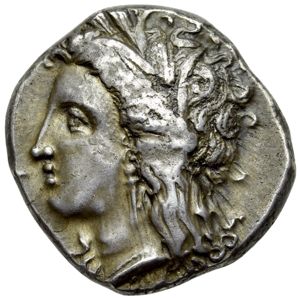
Obverse of coin related to Metapontum: The Barley Ear and Demeter Reverse of coin related to Metapontum: The Barley Ear and Demeter

Metapontum: The Barley Ear and Demeter

The nomos, or didrachm, from Lucania was minted at Metapontum around 330–290 BC. Metapontum, also known as Metapontium (Ancient Greek: Μεταπόντιον, romanized: Metapontion), was an important polis of Magna Graecia, situated on the Gulf of Tarentum, between the rivers Bradanus and Casuentus (modern Basento). Metapontum appears less often in literary sources than its influential neighbour Tarentum, even in the second half of the fourth century and the first quarter of the third century BC, when the interventions of several condottieri from mainland Greece in South Italian affairs are well documented 1.

At Metapontum, the main design pattern was established in the late fifth century BC: the obverse showed the head of a deity, while the reverse showed an ear of barley. This pattern was maintained during the first half of the fourth century, although the heads and their styles varied considerably. The coinage of the quarter-century after the death of Alexander the Molossian continued this tradition, with a long series of issues featuring the head of Demeter on the obverse, as seen on the coin presented here (HN Italy 1582) 1. The ear of barley became the standard coin type of the polis, and the coins were normally struck on the Achaean standard, with a stater weighing around 8 grams 1. Several of the female heads were given names such as Hygieia (Health), Homonoia (Concord), and Soteria (Safety). These names may connect Demeter with ideas of the physical well-being and protection of the community 2.

The final issues of Metapontum belong to the period of the Second Punic War, when Hannibal came close to ending Roman domination in southern Italy before eventually being defeated by Scipio 3.

References

  1. Rutter, N. K. Historia Numorum: Italy. The British Museum Press, 2001, pp. 131–137.
  2. Rutter, N. K. Greek Coinages of Southern Italy and Sicily. Spink, London, 1997, p. 81.
  3. Sear, David R. An Introductory Guide to Ancient Greek & Roman Coins, Volume I. Spink, 2020, p. 85.
Read the full story
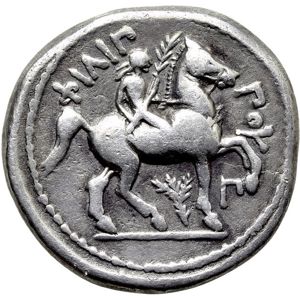
Obverse of coin related to Philip II and the Tetradrachm That Inspired Celtic Imitations Reverse of coin related to Philip II and the Tetradrachm That Inspired Celtic Imitations

Philip II and the Tetradrachm That Inspired Celtic Imitations

After gaining control of the rich Pangaean silver mines, Philip II of Macedon was able to issue coinage on an unprecedented scale. During his reign (359–336 BC), silver tetradrachms and gold coins provided an important source of wealth that helped him recruit mercenaries, finance military campaigns, and extend Macedonian influence throughout Greece.

The tetradrachm became one of the most successful Macedonian coin types. The obverse depicts the laureate head of Zeus facing right, symbolizing divine authority. On the reverse, the inscription ΦΙΛΙΠΠΟΥ identifies the king, while a youthful horseman rides to the right holding a palm branch, an emblem of victory. Additional control marks, including a branch beneath the horse and the letter Π beneath its raised foreleg, probably identified the mint or the officials responsible for production.

The scale of Philip’s silver coinage was remarkable. Around 544 obverse dies have been attributed to the period from approximately 356 to 328 BC 1, suggesting a rate of production far exceeding that of earlier Macedonian kings.

The tetradrachm’s influence did not end at the borders of Macedonia. Philip II’s coinage became widely imitated by Celtic communities, particularly along the Danube. Celtic imitations retained the characteristic combination of Zeus and the mounted horseman, while gradually transforming the original Greek designs into distinctive local styles.

Thus, the Philip II tetradrachm was more than a means of payment: it became one of the most influential Greek coin types of the ancient world 2.

References

  1. Metcalf, William E. (ed.). The Oxford Handbook of Greek and Roman Coinage. Oxford: Oxford University Press, 2012.
  2. Sear, David. An Introductory Guide to Ancient Greek and Roman Coins, Volume II: Regal Coins of the Hellenistic Age. Spink.
Read the full story
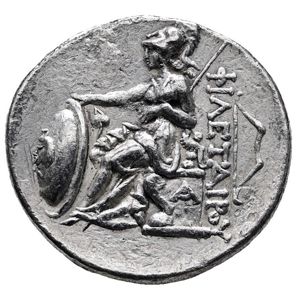
Obverse of coin related to The Tetradrachm of Philetairos Reverse of coin related to The Tetradrachm of Philetairos

The Tetradrachm of Philetairos

Philetairos (c. 343-263 BC) began his career in the service of Lysimachos. He was appointed guardian of the royal treasury at Sardis, which contained approximately 9000 talents of silver.1

Before the Battle of Corupedium in 281 BC, Philetairos turned against Lysimachos. He took control of the treasury and established his own authority in Asia Minor. Although he never adopted the title of king, he laid the foundations of the Pergamene state.

After Philetairos died in 263 BC, his successor, Eumenes I, kept control of the treasury instead of returning it to the Seleucid rulers. Antiochos I Soter responded by declaring war, but Eumenes defeated him.

Under Eumenes I, a tetradrachm was issued bearing the portrait of Philetairos on the obverse rather than the portrait of the current ruler. On the reverse, Athena is shown seated, while the only inscription is ΦΙΛΕΤΑΙΡΟΥ, meaning "of Philetairos".

The portrait is strikingly realistic. Philetairos is shown as a heavy-set, elderly man rather than as an idealised ruler. This reflects a wider development in Hellenistic coinage during the third century BC, when rulers increasingly used realistic portraits and relied less on Alexander the Great as a source of royal legitimacy.

The Philetairos type proved exceptionally durable. It remained in production for approximately a century, during the reigns of Eumenes I, Attalos I, and Eumenes II. Around 200 obverse dies were used during this long period.1

After 188 BC, Eumenes II introduced the cistophoroi and restricted the circulation of foreign silver coinage in Pergamon. The new currency replaced the old tetradrachms and brought the long-lived Attalid silver coinage to an end.1

References

  1. Metcalf, William E., ed. The Oxford Handbook of Greek and Roman Coinage. Oxford University Press, 2012.
Read the full story
Obverse of coin related to The Tetradrachm of Lysimachos Reverse of coin related to The Tetradrachm of Lysimachos

The Tetradrachm of Lysimachos

Lysimachos (c. 360-281 BC) was one of the Diadochi and had previously served as a bodyguard of Alexander the Great. After the Battle of Ipsus, where the territories of Antigonus Monophthalmus were divided, Lysimachos received a large part of Asia Minor.

Although he became king in 306 BC, he did not replace Alexander's name on his coins with his own until approximately 299 or 298 BC. Around 297 or 296 BC, he introduced a new tetradrachm type. The obverse showed the idealised head of Alexander wearing the horn of Ammon, while the reverse depicted Athena Nikephoros-Athena, the bearer of victory-seated.1

The type presented Lysimachos as the legitimate successor of Alexander and suggested a glorious future for his kingdom. It proved so successful that, almost two thousand years later, the seated Athena was used as the model for the allegorical figure of Britannia.

At least 400-450 obverse dies were engraved for Lysimachos' lifetime tetradrachms, issued between approximately 297 and 281 BC.1 This indicates a very large volume of production, with a considerably higher annual output than the coinage of Philip II during his reign. An example of his coinage can be found here: Philip II tetradrachm from Amphipolis.

The tetradrachm soon became popular around the shores of the Black Sea. Many local dynasts and rulers copied the type, and it continued to be produced for almost two centuries after Lysimachos’ death.

References

  1. Metcalf, William E., ed. The Oxford Handbook of Greek and Roman Coinage. Oxford University Press, 2012.
Read the full story
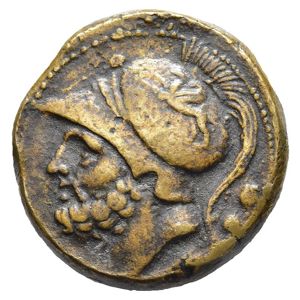
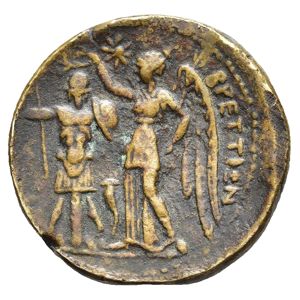
Obverse of coin related to Ares on a Bruttian Bronze Reverse of coin related to Ares on a Bruttian Bronze

Ares on a Bruttian Bronze

This Bronze 'Double' (double-didrachm) with the helmeted head of Ares was the largest of the five bronze denominations minted by the Bruttians. The other denominations were the Bronze 'Unit' (c. 8 grams), Bronze 'Half' (c. 4 grams), Bronze 'Quarter' (c. 2 grams), and Bronze 'Sixth' (c. 1.4 grams) 1. This particular Bronze 'Double' belongs to the so-called 'corn-ear' group, which was minted in 214-211 BC 2, during the Second Punic War.

The Greeks had an ambivalent attitude towards Ares. He was less commonly depicted on ancient coins than gods such as Zeus, Athena, or Apollo, which makes this coin an interesting example of his representation in ancient coinage. Ares embodied the physical courage and strength needed for success in war, but he could also represent brutality and bloodlust. This was different from his sister Athena, whose martial role was associated with military strategy and leadership.

Numismatist M. Jessop Price made another interesting observation about Ares. He argued that Ares represented the traditional Spartan character, although he was not a deity with an important cult at Sparta and never appeared on Spartan coins 3.

References

  1. Scheu, Frederick. “Bronze Coins of the Bruttians.” The Numismatic Chronicle and Journal of the Royal Numismatic Society, Seventh Series, Vol. 1 (1961), pp. 51–66.
  2. Rutter, N. K. Historia Numorum: Italy. The British Museum Press, 2001, p. 159.
  3. Price, M. Jessop. "Greek Imperial Coins: Some Recent Acquisitions by the British Museum." The Numismatic Chronicle, Seventh Series, Vol. 11 (1971), p. 131.
Read the full story
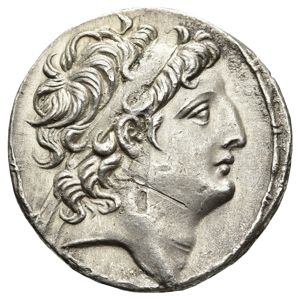
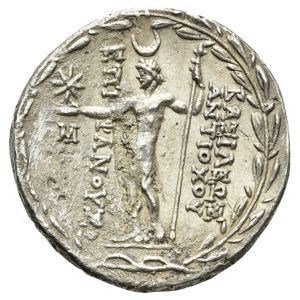
Obverse of coin related to Antiochos VIII Tetradrachm Reverse of coin related to Antiochos VIII Tetradrachm

Antiochos VIII Tetradrachm

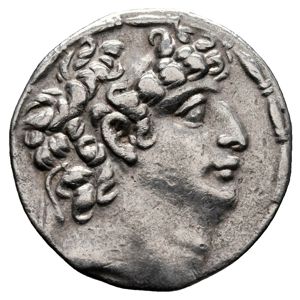
This tetradrachm was minted in Ake-Ptolemais around 120 BC during the reign of Antiochos VIII Grypos. Today, the ancient city is known as Acre (Akko), a historic port city on the eastern Mediterranean coast. At that time, the Seleukid Empire was losing power because of internal conflicts and wars. The coin was made in an important coastal city that connected the Greek world with the Near East. It survived more than 2000 years and still shows the face of a king who lived in the final period of the Seleukid dynasty.

Read the full story
Obverse of coin related to The Pi-Style Athenian Tetradrachm Reverse of coin related to The Pi-Style Athenian Tetradrachm

The Pi-Style Athenian Tetradrachm

After the defeat in the Peloponnesian War (431–404 BC), a long conflict in which Sparta and its allies defeated Athens and its empire, the Athenians gradually resumed the production of their silver coinage during the first half of the fourth century BC. However, they do not appear to have minted coins on anything close to the scale achieved before 415 BC 1.

By the 350s BC, the financial position of Athens remained difficult and required serious corrective measures, going even beyond those later proposed by Xenophon in his Poroi. The Athenians introduced important fiscal reforms, including the use of bronze token fractions. Bronze coinage was not welcomed by everyone. Aristophanes famously used bronze money as an image of declining standards, while works such as the Ecclesiazusae also reflect contemporary criticism and distrust of bronze coinage 2.

Whatever the exact reasons, Athens eventually began another large-scale production of its famous silver tetradrachms. This time, however, the traditional design was significantly updated. The most noticeable change appeared on Athena's helmet, where the floral ornament developed a distinctive pi-like form 3. Production of these so-called pi-style owls reached an enormous scale. As with the later fifth-century owl tetradrachms, so many coins were struck that no scholar has yet attempted a complete die study of the entire series.

But why is this coin called a pi-style Athenian tetradrachm?

Take a close look at Athena's helmet on the obverse. The term pi-style refers to the floral helmet ornament, which resembles the Greek letter pi (π). The ornament is divided by a long central tendril, creating the characteristic shape from which the series takes its modern name.

There are also several other differences compared with the Athenian tetradrachms of the fifth century BC. Athena's face is more refined and naturalistic on the pi-style tetradrachm. The most distinctive features are the fully profile eye and the more naturally rendered ear, both of which mark an important stylistic development from the earlier Classical owl coinage. The pi-style tetradrachm was therefore a new version of the traditional Athenian owl, with several clear changes in style.

References

  1. Kroll, J. H. "Athenian Tetradrachm Coinage of the First Half of the Fourth Century B.C." Revue Belge de Numismatique 157: 3–26.
  2. Kallet, Lisa, and John H. Kroll. The Athenian Empire: Using Coins as Sources. Cambridge: Cambridge University Press, 2020, p. 135.
  3. Metcalf, William E. (ed.). The Oxford Handbook of Greek and Roman Coinage. Oxford: Oxford University Press, 2012.
Read the full story
Obverse of coin related to Plinthophoric Drachm of Rhodos Reverse of coin related to Plinthophoric Drachm of Rhodos

Plinthophoric Drachm of Rhodos

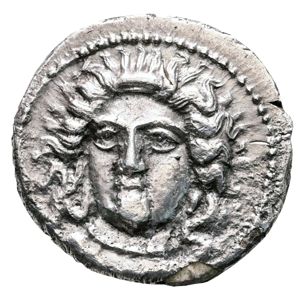
Plinthophoric drachm of Rhodos that I recently acquired. On the obverse of this silver coin you can see Helios. Helios is the god and personification of the Sun, he was the son of Poseidon and Amphitrite. Helios is often depicted with a radiant crown like on this ancient drachm. It is interesting to know that the name of the island Rhodes belong to the goddess and personification of the island who was a wife of the sun god Helios with whom she had seven sons. Lets not delve into Greek mythology (nevertheless, it is interesting piece of the mythology) and will return back to the coin. On the reverse, you can see a rose within an inset square – the eponymous 'plinthos' or 'brick'. Rhodian plinthophoric coinage was minted from 190s down to the early first century BC. In addition, on the reverse we can see the magistrate's name Artemon (ΑΡΤΕΜΩΝ) with abbreviated ethnic R-O (P-O). The name of the magistrate helps to say more precisely when the coin was minted - around 170-150 BC.

Read the full story
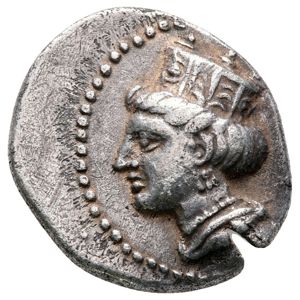
Obverse of coin related to Siglos with Hera Reverse of coin related to Siglos with Hera

Siglos with Hera

Siglos that was issued by the city of Amisos, which was also referred to as Peiraieos. The coin was minted during the approximate time period of 435-370 BC.

The obverse of the coin features a depiction of the head of the Greek goddess Hera facing left. Hera was one of the principal deities in the Greek pantheon and was often associated with marriage and childbirth. This image of Hera served as a symbol or representation of the city or region of Amisos.

The reverse side of the coin features an owl standing facing left on a shield. The owl is a common symbol in ancient Greek coinage and often represents the goddess Athena, who was the patron goddess of Athens. The presence of the owl suggests a connection to Athena, although it's possible that this symbol was used for its association with wisdom and knowledge as well. Surrounding the owl and shield are the Greek letters ΙΗ-ΝΟ, and below, you have the word "ΠΕΙΡΑ" which is an abbreviation for "ΠΕΙΡΑΙΕΥΣ" (Peiraieus), indicating the city of Amisos (Peiraieos). The grain ear in the left field is a common element in ancient Greek coinage and may symbolize agricultural prosperity or a local connection to grain production.

Read the full story
Obverse of coin related to Philip I Philadelphos Tetradrachm Reverse of coin related to Philip I Philadelphos Tetradrachm

Philip I Philadelphos Tetradrachm

One interesting fact about Philip I Philadelphos is that he was known for his deep affection for his sister and wife, Laodice Thea. The title "Philadelphos" (ΦΙΛΑΔΕΛΦΟΥ that you can on this tetradrachm) in his name actually means "Sibling-loving". Their close relationship was evident in their coins and inscriptions, which often emphasized their strong familial bond. This practice was not uncommon among Hellenistic rulers, but Philip I Philadelphos and Laodice Thea are particularly well-known for the prominence they gave to their sibling relationship in the art and symbolism of their time.

Read the full story
Obverse of coin related to Diocletian Follis Reverse of coin related to Diocletian Follis

Diocletian Follis

Diocletian, Roman Emperor from 284 to 305 AD, is renowned for instituting significant administrative reforms known as the Tetrarchy, dividing power between four rulers. During his reign, the Roman currency underwent transformations, with the introduction of the follis, a large bronze coin.

The follis that you see here was minted during Diocletian's reign, it bears the obverse inscription "IMP C C VAL DIOCLETIANVS P F AVG" with a laureate head facing right, depicting the emperor's authority and divine favor. On the reverse, it features "GENIO POPVLI ROMANI" with Genius standing left, symbolizing the spirit of the Roman people, holding a cornucopia and sacrificing with a patera, indicative of prosperity and civic devotion under Diocletian's rule.

Read the full story
Obverse of coin related to Pharnabazus Stater Reverse of coin related to Pharnabazus Stater

Pharnabazus Stater

In the 370s BC, Artaxerxes II of Persia launched an attempt to retake Egypt, which had rebelled against Achaemenid rule. He appointed Satrap Pharnabazus to lead the campaign. Although Pharnabazus was based far away in Dascylium, in northwestern Asia Minor, he set up a secondary base in Cilicia. There, in the city of Tarsus, he minted many staters to fund the operation, as the region had abundant coin-making resources.

Pharnabazus's coins marked a departure from the earlier Tarsus designs. The obverse featured a three-quarter view of a woman's head, inspired by the famous depiction of Arethusa created by the engraver Cimon in Syracuse about 30 years earlier. The back reverse showed a bearded, helmeted male head. While often identified as Ares, the Greek god of war, it might instead represent a Persian satrap — a symbol of Persian authority.

Read the full story
Obverse of coin related to Ptolemaic Didrachm Reverse of coin related to Ptolemaic Didrachm

Ptolemaic Didrachm

Struck under Ptolemy VI Philometor, this Ptolemaic didrachm reflects the dynasty's strong emphasis on continuity and royal legitimacy. The obverse features the diademed head of Ptolemy I, the founding ruler, reinforcing dynastic identity long after his reign. On the reverse, the inscription "ΠΤΟΛΕΜΑΙΟΥ ΒΑΣΙΛΕΩΣ" is paired with an eagle standing on a thunderbolt - one of the most powerful symbols of Ptolemaic authority - along with a date mark below indicating the year of issue. The type was a widely recognized silver denomination used across Egypt for both everyday exchange and state payments.

Read the full story
Obverse of coin related to Stater from Pamphylia Reverse of coin related to Stater from Pamphylia

Stater from Pamphylia

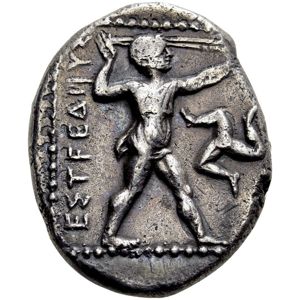
The stater was a widely used ancient Greek coin, struck in silver or gold and circulating broadly across Greece and beyond from the 6th century BCE onward. This example comes from Aspendos in Pamphylia and dates to the 4th century BCE. Its obverse shows two wrestlers locked in a grappling match, a striking reflection of the cultural importance of athletic competition in the Greek world, with the letters "BΛ" placed between them. The reverse features a slinger in motion, a triskeles symbol in the field, and the inscription "EΣTFEΔIIY", whose meaning remains uncertain and is debated - possibly referring to the issuing authority or city, or perhaps representing a personal name.

Read the full story
Obverse of coin related to The Boeotian Shield and Theban Coinage Reverse of coin related to The Boeotian Shield and Theban Coinage

The Boeotian Shield and Theban Coinage

The distinctive Boeotian shield is one of the best-known features of Boeotian coinage. Cities such as Akraiphia, Copai, Coroneia, Mykalessos, and Pharai used this design on the obverse of their coins. Except for Thebes, these cities usually identified their issues with the initials of their ethnic name on the reverse.1

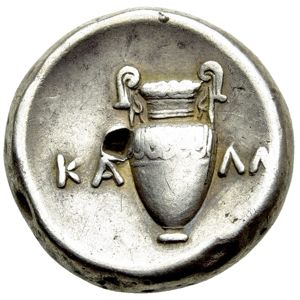
This stater was minted in Thebes, the principal city of Boeotia and a long-standing rival of Athens. During the fifth century BC, the reverse designs of Boeotian coins became increasingly varied. The amphora, a large storage jar, became especially popular at Thebes. It was used as the main reverse type on the extensive coinage issued there between approximately 379 and 338 BC.2 The amphora also appeared on coins minted at Mykalessos.1

The reverse of this coin bears the abbreviation ΚΑΛΛ(Ι), identifying the magistrate responsible for the issue. The coin is classified as group issue D2/3, number 6. According to the magistrate chronology established by Robert Hepworth, it was struck between the terms of the magistrates ΑΓΛΑ and ΤΙΜΟ, the latter being Timolaos.3

The available evidence does not allow the coin to be dated precisely. It was probably issued sometime between 363 BC or possibly 379 BC and 338 BC. The earlier date remains uncertain.

Hepworth also discusses an issue bearing the abbreviation ΞΕΝΟ, associated with the magistrate Xenokrates. He considers this issue a possible forgery. If authentic, it would belong near the end of the series: "if it is not a forgery, belongs to the end of the series".3

References

  1. Metcalf, William E., ed. The Oxford Handbook of Greek and Roman Coinage. Oxford University Press, 2012, pp. 163–165.
  2. Sear, David R. An Introductory Guide to Ancient Greek and Roman Coins, Volume I. Spink, 2020, pp. 128–129.
  3. Gartland, Samuel D., ed. Boiotia in the Fourth Century B.C. University of Pennsylvania Press, 2016, pp. 42–59.
Read the full story
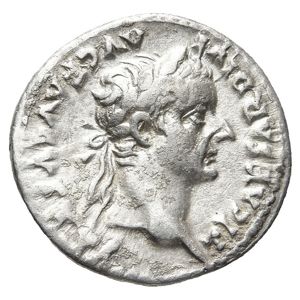
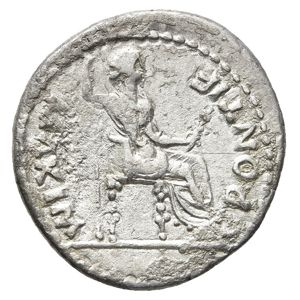
Obverse of coin related to The Tribute Penny Reverse of coin related to The Tribute Penny

The Tribute Penny

The Tribute Penny is famously mentioned by Jesus in the New Testament. Its reverse design proclaims the continuation of the Augustan Peace (Pax Romana), depicting the seated goddess Pax holding a scepter and olive branch. However, the figure is widely interpreted as also resembling Livia, the aging mother of Emperor Tiberius. In this sense, the coin not only celebrates Rome's era of peace but may also serve as a subtle tribute to Livia herself-acknowledging her enduring influence within the imperial family and her possible role in securing Tiberius' rise to the throne.

Read the full story